Category Archives: Uncategorized

NOTICE of 2013 AGM

 All member societies are warmly invited to attend the 2013 Annual General Meeting of the Federation, which will be held at the Australian National University on Saturday 31 August 2013. The meeting will start at 12.30pm.

The AGM is completely open to ideas, so if you have any suggestions on how the federation can improve things for you and other members, please let us know so they can be put on the agenda.

The business of the meeting will be to receive reports of the Federation’s activities during the past year, to conduct elections of office bearers and other Executive members, and to consider any matters of which due notice has been given. This is also a call for nominations of candidates for election, which may be made in writing and received by the secretary before Tuesday 13 August. Candidates can also be nominated from the floor of the meeting.

Each member society is entitled to be represented at the AGM by two delegates who are members of the society they represent. If you can’t send delegates you can appoint a proxy who will vote on your behalf. A proxy doesn’t have to be a member of your society. To appoint a proxy you need to complete the Proxy form and mail or scan/email it to reach the secretary by Tuesday 27 August.

New membership year

In the next day or two all members will receive a letter containing information, and a membership renewal form.

Our new membership year starts on 1 July and runs until 30 June next year. This means that all subscriptions need to be paid by 30 June (there will a period of grace to allow for any unexpected glitches in the new system).

Unlike previous years, you don’t have to make any calculations, because all societies now pay the same amount, $50, regardless of how many members you have. And you can now do everything online, so the whole process can be completed in just a few minutes.

As in previous years, the renewal process is in two parts.

Part 1. Complete a membership renewal form. This can be done online  You can also use the form attached to the letter referred to above or print the form from our electronic form page.

Part 2. Pay your membership subscription. This can be done by Electronic Funds Transfer (EFT) or by cheque. If you pay by cheque, it has to be mailed to the treasurer.

We believe the changes, especially the option to do everything online, will make life a lot easier for everyone. And our treasurer will be eternally grateful if you can make your payment by EFT.

Rick’s Picks

In my role as Vice-President of the Federation. I have been working with the staff of the NFSA to identify films that are in the NFSA Non-Theatrical lending collection but aren’t, in my opinion, being borrowed as much as they deserve to be.

 This is the first of what will hopefully be a regular column where I draw attention to the many excellent films in the Non-Theatrical Lending Collection, available in 16mm prints.

The criteria for the choices are films of quality, prints in good condition (because rarely booked), and the rights not expiring anytime soon. It is hoped that some more bookings of the films will encourage the development of the Collection.

HUMAN DESIRE USA 1954

Director: Fritz Lang. Screenplay:Alfred Hayes, from the novel “La Bete Humaine” by Emile Zola. With Glenn Ford, Broderick Crawford, Gloria Grahame. Also Available on DVDhuman_desire_xlg
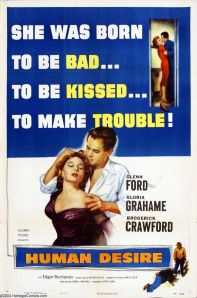
Made by Fritz Lang immediately after “The Big Heat”, “Human Desire” is somewhat overshadowed by the success of that film. It is a remake of Jean Renoir’s 1938 “La Bete Humaine”(The human beast) with Jean Gabin. In the Renoir film the protagonist is a psychopathic sex murderer, which created problems in 50s USA. In this version Glenn Ford plays a Korean War veteran returning to his job as a railroad engineer. He gets drawn into a sordid affair with a violent railroad supervisor’s wife, leading to a murder. Lang uses the railroad yards and trains to striking visual effect.

The 16mm print of Human Desire was acquired from a collector only 3 years ago and is in great condition.

THE RAID USA 1954

Director: Hugo Fregonese. Screenplay: Sydney Boehm from a story “Affair at St Albans” by Herbert Ravenal Sass. With Van Heflin, Anne Bancroft, Lee Marvin, Richard Boone, Peter Graves, Tommy Rettig.
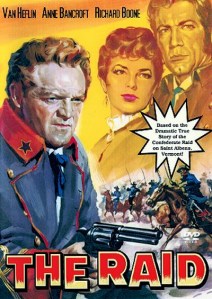
Raid_1954Set during the American Civil War. Van Heflin plays a Confederate officer who enters a Northern town, pretending to be a Canadian businessman, intending to spring a surprise raid. He gets drawn into the life of the town when he falls for a glamorous widow, played by Anne Bancroft. “War makes younger widows”. Her son, played by Tommy Rettig, the star of “The 5000 Fingers of Dr T”, becomes attached to him.

Ironies abound in this fine screenplay, as the officer becomes a town hero when he is forced to shoot one of his men who is about to blow their cover. The scene where Van Heflin, in Confederate uniform, tries to “explain” the rationale for war to a devastated boy is very powerful.

Peter Graves spent many years in Australia, filming the “Whiplash” TV series. A lovely Technicolor print of a little seen underrated minor masterpiece.

 THE SUN SHINES BRIGHT USA 1952

Director: John Ford. Screenwriter: Laurence Stallings, based on three short stories by Irvin S. Cobb. With: Charles Winninger, Stepin Fetchit, Dorothy Jordan, John Russell, Arleen Whelan, Milburn Stone.

“The Sun Shines Bright” is one of John Ford’s greatest films, yet is little-known even among Ford fans. Set in Kentucky in the 1900s, it is a flavoursome picture of small town life, riven by guilty secrets, racial tension and the still open wounds of the Civil War. Little-known actor Charles Winninger gives a magnificent performance as ageing Judge Priest, a warm-hearted yet wily character, standing for re-election, for what will be the last time, against the forces of “progress”, representeddcm142_Sun-Shines-Bright by carpetbagger Milburn Stone.
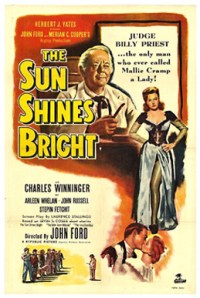
The print of THE SUN SHINES BRIGHT is the version slightly shortened for “B” picture (!) cinema release but all the great scenes are intact. In a just world, Winninger would have won an Academy Award. The scene where the judge stands up to a lynch mob, and (especially) a lengthy funeral sequence, are among the greatest in all cinema. Ford described “The Sun Shines Bright” as “really my favourite, the only one I like to see over and over again”.

WINGS USA 1927

Director: William A. Wellman. Screenplay: Hope Loring, Louis D.Lighton. With: Clara Bow, Charles “Buddy” Rogers, Richard Arlen, Gary Cooper. Silent with inter-titles.

“Wings” won the first Academy Award in 1927, the last silent film to do so until “The Artist” in 2011. It has never been surpassed in its recreation of aerial combat. Wellman, himself a former World War 1 combat pilot, insisted that the combat footage be recreated without the use of models and process shots. The full co-operation of the army ensured authentic simulation of trench warfare.

The simple plot has two airmen competing for the love of the same woman. The two men join the Air Corps in WW1, and become aces. The then rising star Charles “Buddy” Rogers forms a triangle with big star Clara Bow (the “It” girl) and Gary Cooper in a small but stand-out part.
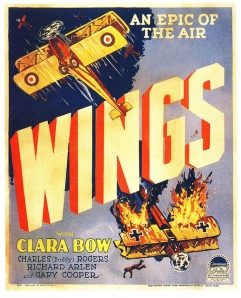
Wings01Unlike many silent films in the NTLC the print of WINGS does not have a music soundtrack. Silent films were never meant to be shown silent. See this not as a threat but as an opportunity. Audiences love silent films with live music accompaniment. Make an occasion of it! A small group of music makers can prepare a score, or a single instrument, usually a piano, works well. Some pianists, especially jazz pianists, are good at improvising. Or a score can be made up using existing music.

John Lanser, from the Workshop Film Group at Willoughby in Sydney, has done numerous scores this way, and would I’m sure be happy to advise.

Richard Keys

More information added to website

Since launching in late February, this website has received 229 different visitors and 1268 page views, which is very encouraging. We have recently added new pages that cover screening rights and a guide to help anyone thinking about starting a film society.

The site is a continuing work in progress. If you think something can be improved, let us know. Likewise if there’s a topic you would like to see featured, request it or send in your material.

Also, The InFilm Bulletin for April has come out and you can find it here.

It covers the launch of the Illawara film Society, The program of the Blacktown Libraries film club, a brief description of the Robert Altman films that are in the NTLC and more.

Welcome

Welcome to the Australian Film Society Federation Website. It aims to tell you everything you need to know about running a film society and to tell the world about you.

Every film society in the Federation has been given an entry on this site, none of them are perfect. Due to privacy concerns I didn’t include personal contact details that weren’t already on the internet.

But if you don’t like your entry I will change it.  Send your changes to me, either through the Tell us your program page  or (if you want to include photos) by emailing me directly on: president afsf @ gmail. com

I would like to thank Jonathan Sykes of the Deerubbin Dangar Island film society for his help with setting up this website. I though that it was great that two film societies can work together and swap information over a distance of 340 km, I hope this website will continue in the same way.

Please explore the site, You can subscribe for updates if you want to, and we would appreciate it if you could post links to us but most importantly, please leave comments. We want to hear from you. To start with give me your comment now. Just click on the “leave a reply” in the top left corner.  What do you want from this website? How do you want to use it?

A response to the misinformation spread by ACOFS

 We have received advice that a spam email from ACOFS and a new ‘NSW Federation’ is circulating among members.

A seperate email has gone out on this subject but the main points are worth repeating here:

1. Madman titles

You have always been able to access Madman titles through Amalgamated Movies, and you can still book them with Amalgamated (Google: www.amalgamatedmovies.com, or refer to recent issues of our IN FILM newsletter). Late last year we commenced discussions with Madman about booking their titles for our members, but with ACOFS and Amalgamated already in the field, we felt it was a bit overcrowded. Now that ACOFS have withdrawn the facility (without letting us know), we’ll be getting back to Madman. Watch this space.

2. DVD Rights

Because you are a legitimate film society, you are entitled to any concession that is made available by any participating distributor.  

The 1 January 2013 arrangement between ACOFS and Roadshow is not exclusive. We have exactly the same arrangement in place with Roadshow.

Amalgamated, Madman and other distributors have not changed their DVD/BluRay concessional rate, which is still $50 + GST ($5) = $55, regardless of membership.

If a film society can demonstrate to a distributor that it is not-for-profit, subscription based and doesn’t charge for admission, it is eligible to access that distributor’s DVD concessional rate, regardless of whether the society is a member of a federation or not. We have always been upfront on this point but societies benefit from the Federation doing the work on their behalf.

Newcastle German Kino Society (NGKS)

 “The Royal Exchange Theatre”, Newcastle, 4th Monday each month (Feb-Nov)

All NGKS screenings are held at The Royal Exchange Theatre 32-34 Bolton St Newcastle. Doors open at 7pm for a 7.30 pm film start. For membership/entry details & up-to date program please seehttp://royalexchangenewcastle.com.au/deutscher-filmklub-stammtisch/.

If no classifications are outlined films are restricted to persons of 18+ years. This may not relate to the film contents but is but due to legal requirements set by the Classification Board.

We are looking forward to seeing you at the monthly NGKS Movie nights.

With warm regards,

The NGKS Committee


Insurance for Federation members

The federation’s film insurance scheme is now in place. This is an extraordinary benefit to members who would otherwise have to pay enormous premiums, or stop screening film altogether. It is very simple and works as follows:

1. Eligibility: If you screen film, your membership of the Federation will entitle you to cover for any claim for film damage or loss incurred while a film you have booked or screened is in your custody or in transit.

2. We will pay: The federation will pay costs:

  • to a maximum of $5,000 for 35mm
  • to a maximum of  $2,500 for 16mm
  • to a maximum of $5000 for DVD, Bluray, E-Cinema, 2K, 4K and DCP

3. subject to the following conditions:

(a) When joining the federation or renewing its membership, a society will be required to warrant that it will observe ‘best practice’ concerning maintenance of its projection equipment and the handling of film. In this instance, ‘best practice’ for 16mm means (a) applying relevant sections of the 16mm Projectionist’s Manual, and (b) seeking expert advice from technicians, accredited projectionists and others who have worked with film for many years. If you screen 35mm, you are likely to already have a maintenance program in place with a specialist technician. If not, the principles in the manual apply equally to 35mm film and equipment.

(b) Each claim will be subject to a $100 excess that will be deducted from the claim payment.

Perhaps the best thing to come out of this exercise was that it made us reflect on how film screeners can best protect themselves against anything happening to film. We concluded that the 16mm Projectionist’s Manual is probably the most comprehensive reference readily available to film societies. It was given a big tick by the experts at the National Film and Sound Archive when it was first published, and the latest edition has again passed their scrutiny with flying colours.

Big changes at special general meeting

The special general meeting held in Canberra on 15 December was something of a milestone. Several major decisions were made put the Federation in a strong position to meet the challenges of the future.

Major decisions made at the meeting were:

1. Changes to the constitution. If you would like a copy of the new constitution, just contact us (contact details at the end of this issue). The constitution also makes great bedtime reading. If you have trouble getting to sleep, start reading and you’ll be snoring by page 3.

2. Our name (as you will have already noticed at the top of the page) is now Australian Film Societies Federation Inc. After an exhaustive debate and voting process, this name emerged as the people’s choice. It might sound a bit strange at first, but by this time next year it will be part of the furniture.

3. Election of the Executive. The Executive comprises seven members, and the following were elected:

President: James Sandry; Vice president: Richard Keys; Secretary: Michael Lines-Kelly: Treasurer: Megan Finlayson; Other officers: Brian Dunne, Bryan Putt and Hilton Prideaux.

But the best thing about the meeting was that everyone there was more interested in talking about film than constitutions and legal rigmarole. Before and after the business sessions, little groups gathered to discuss what they were programming; who distributes what; comparisons of different digital formats, and so on.

News from the NFSA

Following the recent special general meeting, the National Film and Sound Archive’s John Brady spoke at length about the Archive’s structure, operations and services. Borrowers from the Non-Theatrical Lending Collection will have since received an e-letter from the team at the collection, and much of what John said is included. If you didn’t receive a copy, let us know and we’ll send you one.